
Here’s a scenario that plays out every single day in every market across the country.
A homeowner’s HVAC goes out at 7 pm. They grab their phone, type “AC repair near me,” and within seconds, they’re calling the first business that appears on the screen. That business gets the job. It’s a $3,400 repair. And the owner is already on the phone booking the next call.
This guide is specifically written for owners and marketers of home service businesses looking to grow their customer base through Google advertising.
That business isn’t winning because it’s better than yours. It’s winning because it’s running Google Local Service Ads — and you might not be.
Google Local Service Ads (LSAs) are the only Google ad format where your business sits above every other result on the page — above paid search ads, above the map pack, above every organic listing. Google Local Service Ads are a form of google advertising designed to help local businesses stand out with local ads and connect with more customers. And unlike traditional advertising, you don’t pay for eyeballs or clicks. You pay only when a real customer calls, messages, or books directly through your ad.
With LSAs, businesses on Google can receive leads directly from potential customers through phone calls and messages, making it easy to manage and respond to new opportunities. Local Service Ads help you book more jobs and generate new leads in the communities you serve.
For local home service businesses — HVAC, plumbing, electrical, roofing, landscaping, and dozens more — there is no more direct, cost-efficient path to a ringing phone than Google Local Service Ads.
With Local Service Ads, you only pay for customers — not clicks — emphasizing the pay-per-lead model.
This guide covers everything you need to know: what LSAs are, how they work, what they cost, how to rank, and how to get set up the right way.
Understanding how to leverage Google Local Service Ads can be the difference between steady business growth and missed opportunities in today’s competitive local markets.
What Are Google Local Service Ads?
LSAs connect local service providers with customers actively seeking their service.
They help local service businesses connect with potential customers in their area.
Google Local Service Ads are a pay-per-lead advertising format that places verified local service businesses at the very top of Google search results.
Google Local Service Ads (LSAs) operate on a pay-per-lead model, meaning businesses only pay when someone contacts them through the ad.
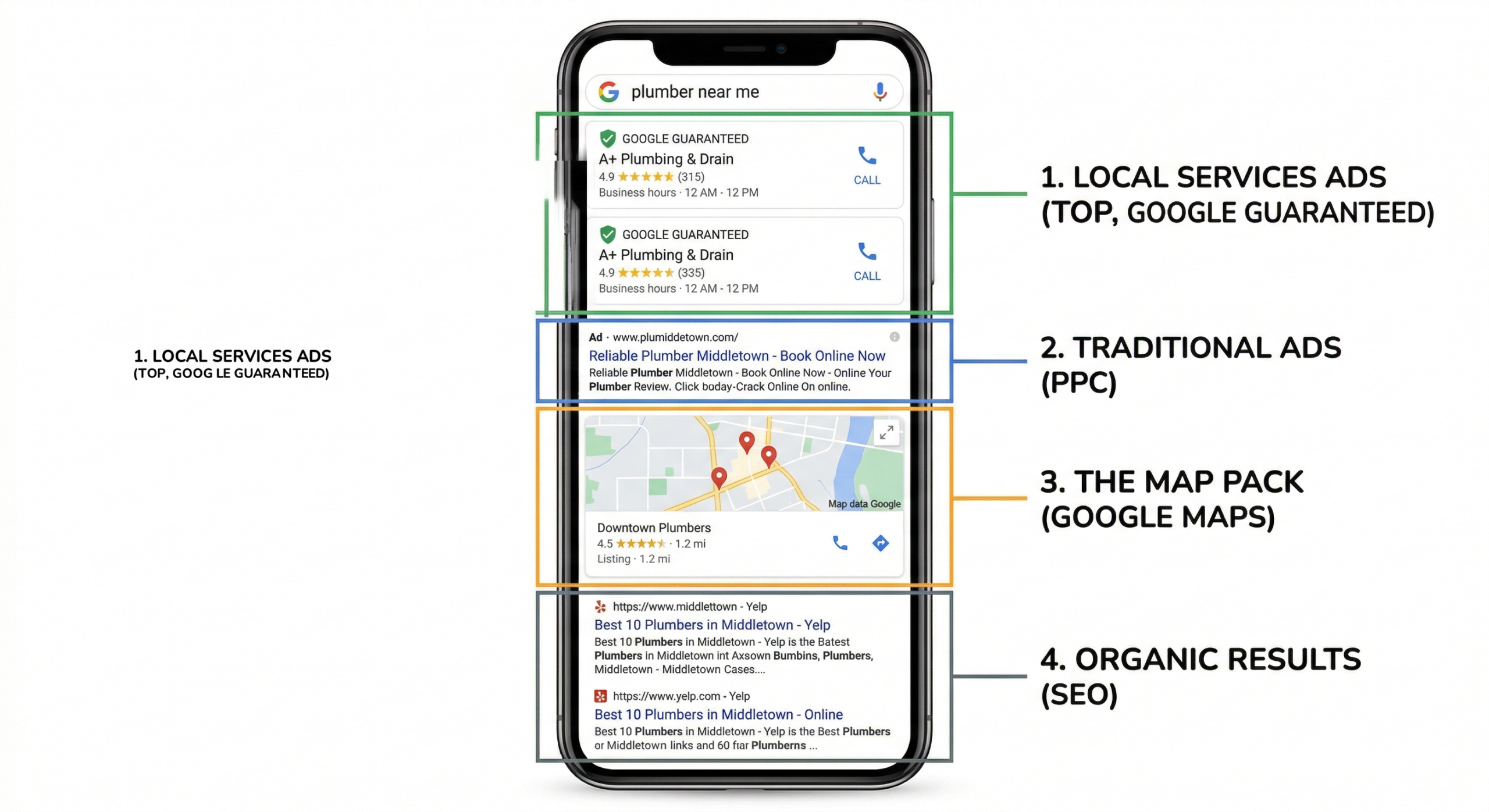
When a homeowner in your area searches for “plumber near me,” “HVAC repair,” or “roofing company,” your LSA appears first. Customers can see your business name, star rating, number of reviews, company profile, service offered, hours of operation, your phone number, and a Google Verified badge confirming that Google has screened and approved your business.
When potential customers tap on your ad, they can either call or message your business directly. This interaction generates leads directly from potential customers, facilitating direct communication and resulting in high-quality leads. You can efficiently manage inquiries and bookings as customers reach out to you through the ad.
That’s the entire model. No complicated funnels. No website required. No paying for clicks that never convert. You pay only when someone makes direct contact with your business through the ad.
LSAs appear across:
Google Search — at the very top of results, above everything else
Google Maps — surfaced for local service searches within your area
Mobile Search — the dominant experience for most local service queries
Google Assistant — voice search responses for queries like “find an electrician near me”
Key Insight:
LSAs occupy what marketers call “Position Zero” — the most valuable real estate on the internet for local search. No other format gives a local service business this level of visibility.
How Google Local Service Ads Work
The Pay-Per-Lead Model
This is the single most important thing to understand about LSAs, and the thing that makes them fundamentally different from every other form of online advertising.
With traditional Google Ads, you pay every time someone clicks your ad — whether they call you, whether they’re even in your service area, whether they’re looking for something you actually offer. You pay for the click. What happens after is up to chance.
With LSAs, you pay only for leads. A lead is counted when a customer calls you, sends you a message, or books an appointment directly through your ad. No contact, no charge.
You set a weekly budget, and Google uses it to show your ad to the most relevant local searchers. When someone reaches out, Google charges your account for that lead. If you receive a lead that’s spam, a wrong number, outside your service area, or for a service you don’t offer, you can dispute it within 30 days and receive a credit back.
The Google Verified Badge
Every business that runs LSAs must pass Google’s verification process. As of October 2025, Google consolidated its previous trust badges — Google Guaranteed, Google Screened, and License Verified — into a single, unified Google Verified badge.
To earn the Google Verified badge, your business must complete:
Background checks for the business owner and field employees (where applicable)
License verification at the state or provincial level
Proof of general liability and professional liability insurance
Business registration and identity confirmation
A verified and linked Google Business Profile
The verification process typically takes 2–4 weeks. Once approved, the Google Verified badge appears on your ad — and it matters. Customers searching for a plumber or an electrician aren’t browsing. They have an urgent need, and they want to know they can trust who they’re calling. The badge tells them Google has already done the vetting on their behalf and reinforces a values-driven, trustworthy approach to serving small businesses.
It’s worth noting that the money-back guarantee associated with the old Google Guaranteed badge has been discontinued as part of this consolidation. The badge now functions purely as a trust and verification signal — which, for most consumers, is exactly what they needed in the first place.
Who Qualifies? Eligible Industries and Categories
As of 2025, Google Local Service Ads are available in more than 100 eligible business categories across eight major sectors. If you run a local service business, there’s a strong chance you qualify. Small businesses in eligible categories—such as electricians, plumbers, and HVAC companies—can use Local Service Ads to increase their visibility and generate leads as part of a broader strategic marketing system designed to drive growth, making LSAs a valuable tool for local businesses looking to grow.
Home Services
This is the core LSA audience — the businesses for whom this ad format was originally built and remains most powerful:
HVAC (heating, ventilation, and air conditioning)
Plumbing
Electrical
Roofing
Landscaping and lawn care
Pest control
House cleaning and maid services
Appliance repair
Carpet cleaning
Air duct cleaning
Handyman services
Garage door repair and installation
Painting (interior and exterior)
Moving services
Window cleaning and replacement
Water damage restoration
Foundation and structural repair
Pool and spa services
Other Qualifying Categories
LSAs have expanded well beyond home services. Businesses in the following sectors may also qualify, depending on location:
Business Services: Lawyers, real estate agents, financial advisors, accountants
Health: Dentists, primary care physicians, therapists, chiropractors
Automotive: Auto repair, auto body shops, roadside assistance
Learning: Tutoring, preschool, driving instruction
Care: Child care, elder care, pet care and boarding
Wellness: Massage therapy, yoga instructors, personal trainers
Beauty: Hair stylists, aestheticians, nail technicians
Not sure if your business qualifies? If you’re exploring LSAs as part of a bigger digital strategy, it helps to stay current with modern marketing insights on search, AI, and lead generation.
Google’s LSA eligibility checker takes less than two minutes. Enter your business type and zip code — you’ll know immediately.
How Much Do Google Local Service Ads Cost?
There is no minimum budget required to run LSAs, but Google recommends setting a minimum budget to generate at least 10 leads per week for effective results. Bidding strategies and ad placement are critical factors in the success of your Local Service Ads campaign, as Google uses an auction system to display the highest-ranked Local Service Ads first. You control exactly how much you spend each week, and you can adjust your budget and lead goals, pause, or stop at any time after setup. The cost per lead for Google Local Service Ads can be higher than the cost per click for traditional Google Ads, especially for competitive keywords. What you pay per lead depends on your industry, your market, the level of local competition, and your bidding strategy.
Here are current benchmark cost-per-lead (CPL) ranges for common home service categories:
|
Industry |
Average Cost Per Lead |
|---|---|
|
House Cleaning |
$12 – $20 |
|
Pest Control |
$18 – $45 |
|
Landscaping / Lawn Care |
$20 – $55 |
|
Appliance Repair |
$25 – $60 |
|
Electrician |
$30 – $70 |
|
Plumbing |
$35 – $85 |
|
HVAC |
$45 – $110 |
|
Roofing |
$60 – $130 |
|
Water Damage Restoration |
$100 – $180 |
|
These ranges shift based on local market competition, the time of year (storm season drives roofing CPLs significantly higher, for example), and your bid strategy. In less competitive markets, CPLs can fall well below these benchmarks — giving early movers a meaningful advantage. | |
|
The most important number, though, isn’t your cost per lead. It’s your cost per booked job — and what that job is worth to your business. An HVAC company paying $90 per lead that converts one in three calls into a $2,000 system replacement is generating an extraordinary return on every dollar spent. That math works in almost every home service category where LSAs are available. |
Which Businesses Benefit Most from Google Local Service Ads?
Not every business gets equal value from LSAs. The businesses that see the strongest ROI share a few common traits:
The Math:
If your average job is worth $800 and you’re paying $65 per lead, you need to convert roughly 1 in 12 leads to break even. Most well-run home service businesses convert 1 in 3 to 1 in 5. The return is not even close.
Google Local Service Ads vs. Google Search Ads: What’s the Difference?
This is one of the most common questions local business owners ask — and the answer is: they’re different tools that serve different purposes. Here’s the breakdown:
|
Factor |
Local Service Ads |
Google Search Ads |
|---|---|---|
|
Payment model |
Pay per lead |
Pay per click |
|
Ad position |
Above all ads and organic results |
Below LSAs, above organic |
|
Setup complexity |
Low — profile-based |
High — keywords, bids, ad copy |
|
Targeting |
Service area + job type |
Keywords, demographics, devices, remarketing |
|
Trust signal |
Google Verified badge |
None inherent to the format |
|
Creative control |
Limited — driven by your profile |
Full — headlines, descriptions, extensions |
|
Best for |
High-intent local lead generation |
Broader reach, brand awareness, specific offers |
|
The most important strategic insight here: LSAs and Google Search Ads are not an either/or choice. Running both simultaneously means your business occupies two distinct premium positions on the same search results page. LSAs at the top with the trust badge. Search Ads directly below. Competitors are pushed further and further down the page. | ||
|
For local service businesses with a meaningful ad budget, running both is the dominant strategy. For businesses just getting started with paid search, LSAs are the right place to begin — lower complexity, lower risk, faster results, especially when paired with a purpose-driven brand growth strategy and execution partner. |
How Google Decides Who Ranks — and How to Rank Higher
LSAs are not a pure auction. Throwing more money at your campaign is not enough to guarantee top placement. Google uses a composite ranking system that weighs multiple factors simultaneously — which means every business in your market has the opportunity to outrank a competitor that’s simply outspending them.
Here are the six factors that drive LSA ranking:
1. Review Volume and Recency
Reviews are the highest-visibility trust signal in your LSA profile — and they’re a direct ranking input. Google rewards businesses with more reviews, higher average ratings, and reviews that have been posted recently. Businesses with a minimum of five reviews are required to rank at all; businesses with 50+ recent reviews have a significant visibility edge over those with fewer.
The practical implication: build a systematic process for asking every completed customer to leave a Google review. Not occasionally. After every single job.
2. Response Speed
Google actively monitors how quickly you answer calls and respond to messages that come in through your LSA. Answering calls promptly is a positive ranking signal. Missed calls, voicemails, and slow message responses are negative signals — and they compound over time. A business that answers every call ranks above a business that lets calls go to voicemail, even if the second business is spending more on ads.
3. Budget and Bid Strategy
Budget matters — but not in isolation. Setting a budget that’s too low artificially limits how often your ad is shown, regardless of how strong your profile is. Selecting effective bidding strategies and optimizing ad placement are critical factors in the success of your Local Service Ads campaign. The “Maximize Leads” bidding strategy, which lets Google optimize your bids automatically, consistently outperforms manual bidding for most home service businesses. Set your budget at a level that matches your actual capacity to answer calls and book jobs.
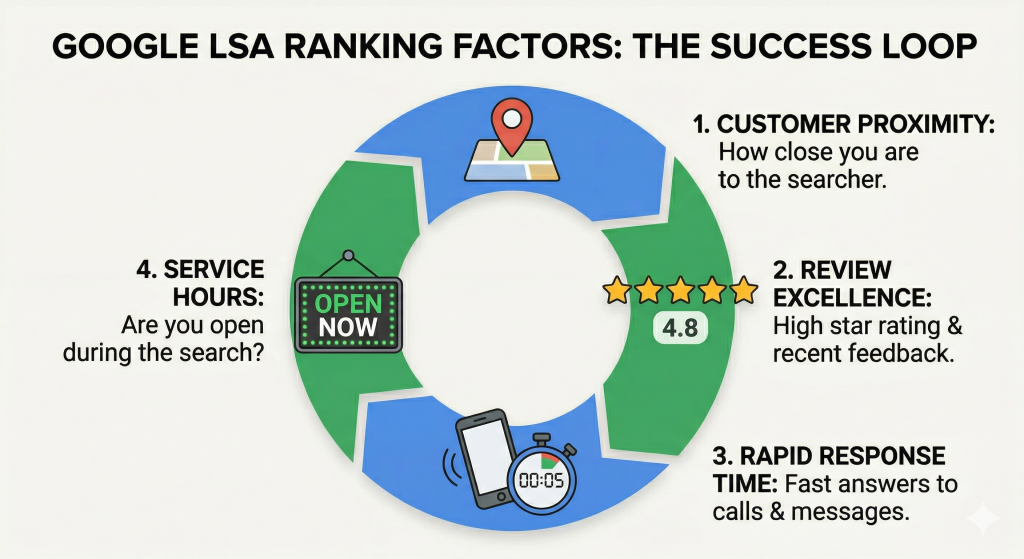
4. Profile Completeness
Google can only show your ad for searches that match the services you’ve listed on your profile. If you haven’t selected every service category that applies to your business, you’re invisible for every search that doesn’t match your listed services — even if you offer that service every day. Clearly listing all the services you offer is crucial to ensure your ads appear for relevant searches and attract more leads. Fill out your profile completely: every service type, your full service area, accurate hours, a strong business description, and professional photos.
5. Call Quality
Google uses AI to analyze the quality of calls that come through LSAs. It’s assessing whether your team is professional, responsive, and converting leads into booked appointments. This is a signal that most businesses don’t think about — but it means the way your phone is answered has a measurable impact on your ad placement.
6. Google Business Profile Accuracy
Your LSA account must be linked to an active, verified Google Business Profile. Inconsistencies between your LSA profile and your GBP, name, address, phone number, and hours create trust signals that work against your ranking. Keep both accounts aligned and up to date.
Quick Wins to Improve Your LSA Ranking This Week:
Answer every call, even unknown numbers
Text every completed customer asking for a Google review
Open your LSA dashboard and check that every applicable service is selected
Update your hours to match your actual availability
Upload 5+ high-quality photos of your team and work
How to Get Started with Google Local Service Ads
Setting up LSAs is more straightforward than traditional Google Ads, but getting it right matters — a poorly configured profile or incomplete verification will limit your results from day one. Here’s how to approach it:
Step 1: Check Your Eligibility
Click here to check your eligibility. Enter your business type and zip code to confirm you qualify. Eligibility varies by service category and geography, so verify before investing time in the setup process.
Step 2: Create Your LSA Profile
Build out your profile completely — business name, address, every service category that applies to your business, your service area (set it as broadly as you realistically serve), business hours, and high-quality photos. Make sure to provide complete and accurate business hours service information and detailed descriptions of your services, as this is essential for optimizing your Google Local Service Ads (LSAs) performance and relevance. Do not cut corners here. An incomplete profile is a ranking disadvantage from the moment you go live.
Additionally, LSAs require a Google Business Profile that must be active in order to run ads. A Google Business Profile is a free business listing on Google that helps your business show up in local search and maps results, and it should work hand in hand with a clear, conversion-focused website presence.
Step 3: Complete the Verification Process
Submit your business license(s), proof of insurance (general liability at minimum), and authorize background checks for the business owner and applicable field employees. Google’s verification partner will complete the screening process. Plan for 2–4 weeks from submission to approval — start this immediately after creating your profile.
Step 4: Link Your Google Business Profile
Connect your LSA account to your verified Google Business Profile. This is required for the Google Verified badge and for your reviews to appear on your LSA. If your GBP isn’t verified yet, handle that before or during the LSA setup process.
Step 5: Set Your Weekly Budget
Choose a budget that reflects how many leads your team can realistically handle. If you can book five new jobs per week, don’t set a budget that generates 30 leads — you’ll miss calls, hurt your ranking, and waste spend. Start conservatively, measure your response rate and conversion rate, then scale.
Step 6: Go Live and Monitor Actively
Once approved and live, check your LSA dashboard regularly. Review every lead, respond immediately to messages, dispute any invalid leads within 30 days, and track which lead sources are converting into booked jobs. Optimization is not a one-time task — it’s an ongoing process that compounds over time.
Common Mistakes That Waste Your LSA Budget
Most businesses that run LSAs and don’t get results aren’t dealing with a platform problem. They’re dealing with an execution problem. Here are the mistakes that most commonly kill LSA performance:
Setting the budget and never touching it again. LSAs require active management. Market conditions, competition, and seasonality all shift — your budget and settings should shift with them.
Not answering calls promptly. Every missed call is a lost lead and a ranking penalty. If your team can’t answer during business hours, you’re paying for leads you’re giving away to your competitors.
Failing to dispute invalid leads. Spam calls, wrong numbers, and out-of-area leads happen. You have 30 days to dispute them and get your money back — use that window every time.
Not requesting reviews after every completed job. Reviews are a ranking factor and a trust signal. A manual or automated review request process — a simple text after each job — is the highest-leverage thing most home service businesses aren’t doing consistently.
Selecting only a handful of service types. Every service you don’t select is a search you’re invisible for. Go through your service list and enable everything that legitimately applies to your business.
Running LSAs without an optimized Google Business Profile. Your GBP and LSA profile feed each other. An unverified, incomplete, or inconsistent GBP undermines your LSA performance.
Tracking only lead volume, not booked jobs. Leads that don’t convert are just expenses. Know your lead-to-booking rate — that’s the number that tells you whether your LSA investment is actually working.
How to Inspire Confidence with Google Local Service Ads
Inspiring confidence is essential for local service businesses looking to attract more customers through Google Local Service Ads. When potential customers see your ad, they’re often making a quick decision about whether to trust your business with their home or project. Here’s how you can make your business stand out and inspire trust from the very first impression:
Optimize Your Google Business Profile: Make sure your Google Business Profile is complete, accurate, and up to date. Include all relevant business information, business hours, and a detailed list of services offered. Consistency between your profile and your LSA is key to building credibility.
Showcase High-Quality Photos: Upload professional photos of your team, completed projects, and your business in action. Visuals help customers connect with your brand and see the quality of your work.
Collect and Highlight Excellent Reviews: Encourage every satisfied customer to leave a review. Positive, recent reviews not only improve your ranking but also reassure new customers that you deliver great service.
Craft Clear and Compelling Ad Copy: Use your ad space to highlight what makes your business unique—whether it’s years of experience, special certifications, or a satisfaction guarantee. Make your value proposition clear and concise.
Respond Promptly to Inquiries: Fast, friendly responses to calls and messages show customers you value their business and are ready to help. Google tracks your responsiveness, and so do your potential customers.
Deliver Outstanding Customer Service: Every interaction is an opportunity to build trust and loyalty. Go above and beyond to ensure customers are happy, and your reputation will grow—both online and offline.
By focusing on these areas, your Google Local Service Ads will not only attract more customers but also inspire the confidence needed to turn leads into loyal clients. Remember, trust is the foundation of every successful local service business—and your online presence is often where that trust begins.
Why LSAs and Local SEO Work Best Together
LSAs give you immediate, paid visibility at the top of the page today. Local SEO builds your organic presence in the map pack and below the fold over time. Optimizing for local searches is essential for improving your business’s visibility and attracting nearby customers, as accurate listings and proximity help your ads and profiles stand out in Google Maps and search results. These are not competing strategies — they are complementary systems that, when run together, produce something greater than either can deliver alone.
Google Local Service Ads provide immediate visibility at the top of the page, while Local SEO builds organic presence over time.
Your LSA appears at the very top of search results with the Google Verified badge
Your Google Business Profile appears in the map pack directly below
Your website appears in organic results below that
A competitor looking at that results page sees their listing buried. A customer looking at that results page sees your business three times before they see anyone else. That’s not a coincidence — it’s a deliberate strategy, and it’s available to any local service business willing to execute on both channels simultaneously.
There’s a compounding benefit as well: the reviews you collect through LSAs strengthen your Google Business Profile. A stronger GBP supports better local SEO rankings. Better local SEO rankings reduce your dependence on paid advertising over time, improving your overall marketing efficiency. The two channels build on each other in ways that neither can accomplish alone.
Frequently Asked Questions About Google Local Service Ads
Do I need a website to run Google Local Service Ads?
No. LSAs run entirely off your ad profile — customers contact you directly through the ad, not through a website. That said, a well-built website still plays an important role in building trust and supporting your overall local SEO strategy. For LSAs specifically, it’s not a hard requirement.
How long does LSA verification take?
The verification process typically takes 2–4 weeks from the time you submit all required documents — license, insurance, and background check authorization. Starting the process immediately after creating your profile is the best approach. Delays in document submission extend the timeline.
What replaced the Google Guaranteed badge?
As of October 20, 2025, Google unified its three previous trust badges — Google Guaranteed, Google Screened, and License Verified — into a single Google Verified badge. Most businesses transitioned automatically. The money-back guarantee associated with the old Google Guaranteed badge was discontinued as part of this change. The Google Verified badge now serves as the universal trust signal across all LSA categories.
Can I dispute leads I shouldn’t have been charged for?
Yes. You have 30 days from the date of a lead to dispute it through your LSA dashboard. Valid dispute reasons include spam or robot calls, a customer contacting you for a service you don’t offer, a caller outside your service area, and duplicate leads. Review your lead log regularly and dispute anything that doesn’t qualify as a legitimate contact.
Should I run both LSAs and Google Search Ads at the same time?
Yes, if your budget allows. They occupy different positions on the search results page and serve complementary purposes. LSAs deliver pay-per-lead placement at the very top. Search Ads deliver pay-per-click placement below LSAs but above organic results. Running both means your business appears twice on the same page, pushing competitors further down. It’s the dominant local search strategy for any business serious about market share.
How many Google reviews do I need to run LSAs effectively?
Google requires a minimum of five reviews for full ranking eligibility. In practice, businesses with 20+ recent reviews see materially better placement than those with fewer. The more reviews you have — and the more recent they are — the stronger your ranking signal. Treat review generation as an ongoing operational process, not a one-time push.
What’s the difference between LSA leads and regular Google Ads leads?
LSA leads are direct contacts — someone called your business phone number or sent a message specifically to reach you. They have an active, immediate need for your service. Traditional Google Ads leads click through to your website, where they may or may not take action. LSA leads have already decided to make contact. The intent level is higher, the conversion path is shorter, and the close rate is typically stronger.
Measuring Success with Google Local Service Ads
To get the most out of your Google Local Service Ads, it’s essential to measure your results and use data to guide your marketing strategy. Tracking the right metrics helps local service businesses understand what’s working, where to optimize, and how to maximize return on ad spend.
Start by monitoring the number of leads your ads generate—these are direct contacts from potential customers who found you through Google Local. Next, calculate your conversion rates: how many of those leads turn into booked jobs or paying clients? This gives you a clear picture of your campaign’s effectiveness.
Cost per lead is another critical metric. By dividing your total ad spend by the number of qualified leads, you can see exactly how much you’re paying to acquire each new customer. Compare this to your average job value to ensure your campaign is profitable.
Don’t forget to review your ad performance regularly. Check your ad’s position in search results, your click-through rate, and how often your ad is shown to local customers. Google’s built-in reporting tools make it easy to track these metrics and spot trends over time.
By consistently measuring and analyzing these key performance indicators, you can optimize your campaign, adjust your budget, and focus on the strategies that deliver the best results. Many businesses choose to collaborate with a marketing partner accountable for ongoing performance and growth to keep this optimization on track. With a data-driven approach, your local service business can attract more customers, improve conversion rates, and achieve your marketing goals with Google Local Service Ads.
Ready to Get Your Phone Ringing?
Google Local Service Ads are the most direct, highest-visibility, most cost-efficient lead generation tool available to local service businesses right now. You pay only when a real customer contacts you. You appear above every other result on Google. You win trust instantly with the Google Verified badge.
And your competitors, in most markets, are either not running them or running them poorly.
The window for early-mover advantage in your market is open. But it won’t stay open. Every month that passes is another month of leads going to whoever got set up first and got it right.
Getting LSAs set up the right way — verification, profile optimization, review strategy, budget configuration, lead management, and integration with your Local SEO — is the difference between a campaign that generates a consistent pipeline and one that quietly drains your budget while your phone stays quiet.
At Markexe, we set up and manage Google Local Service Ads for home service businesses throughout Louisville and beyond. We handle the setup, the optimization, the review strategy, and the ongoing management — so you can focus on doing the work, not figuring out the ads. When you’re ready for a deeper conversation about your goals, you can start with a casual coffee meeting with Adam to talk strategy.
If you’re ready to start generating leads from the top of Google, let’s talk. A conversation costs you nothing. Missing another month of leads does.